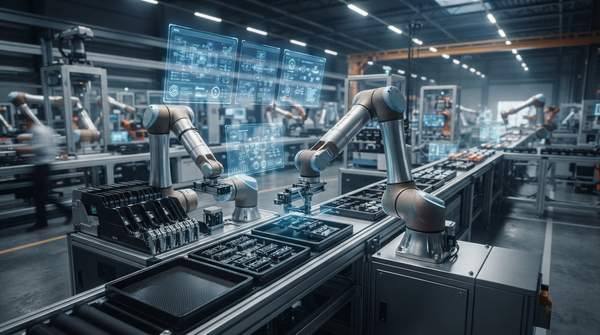
At the Delta Future Industry Summit 2026 in Bangkok, over 200 government, industry, and technology leaders converged to examine the next phase of industrial automation. The event highlighted a future where AI advanced systems are becoming increasingly intuitive and autonomous. Discussions featured a demonstration developed with Google Cloud, showcasing AI agents that interpret handwritten instructions to direct robots in identifying, locating, and kitting parts. This capability bridges highly unstructured human input with precise robotic execution, marking a significant step towards more adaptable factory floors and enhancing industrial manufacturing efficiency in 2026. Further advancements included FANUC’s CRX Vibe Coding demonstration, which employs generative AI and natural-language commands to automatically create Python code and robot programs, streamlining complex tasks and accelerating deployment cycles for new automation.
Industrial AI is demonstrating powerful capabilities in automating complex tasks and optimizing operations, but its widespread, effective deployment hinges on developing new leadership roles and robust governance strategies. This rapid integration of AI-powered automation poses a critical challenge: while technological readiness is advancing quickly, the organizational capacity to manage and oversee these systems may be lagging. Manufacturers face the dual imperative of adopting cutting-edge tools while simultaneously building the necessary human and systemic infrastructure to ensure their long-term success and mitigate emerging risks.
Companies are racing to integrate AI for efficiency and autonomy, but success will depend less on the technology itself and more on their ability to cultivate specialized human expertise and strategic implementation frameworks. This argues that the true competitive advantage will come not just from deploying advanced AI, but from establishing comprehensive oversight mechanisms and fostering a workforce capable of navigating the complexities of highly autonomous industrial environments. Effective integration requires a concurrent focus on technological advancement and the establishment of robust operational oversight to prevent unforeseen vulnerabilities.
AI's Real-World Footprint: From Factories to Job Sites
- Caterpillar is collaborating with FieldAI to advance physical AI, autonomy, and robotics for safer and more efficient job sites and factories, according to International Mining. This partnership aims to transform hazardous industrial environments through intelligent automation.
- The collaboration specifically combines Caterpillar's extensive industry expertise with FieldAI's AI-enabled robot foundation models. This synergy allows systems to autonomously operate across complex and dynamic environments, from construction sites to large-scale manufacturing facilities, reducing the need for constant human supervision.