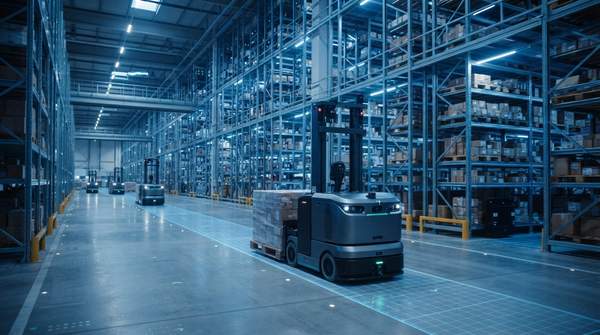
By May 2027, Kia's AutoLand Hwaseong assembly complex will deploy autonomous forklifts from Hyundai Wia. These advanced machines load cargo entirely on their own, operating at 6.5 kilometers per hour, according to The Korea Times. This deployment marks a significant real-world application of fully autonomous logistics in a major industrial setting.
Industrial logistics are rapidly adopting highly complex autonomous systems across various sectors. However, the full scope of operational and workforce implications arising from this rapid technological shift is still being understood. This creates a tension between accelerating automation and the comprehensive societal adjustments required.
Companies are increasingly trading traditional human oversight for data-driven, simulated control. Mastering this integration of autonomous robotics with real-time digital twins offers a significant competitive edge, creating self-improving, predictive operational ecosystems.
The Autonomous Forklift: A New Benchmark for Logistics
The Hyundai Wia autonomous forklift, designed for heavy industrial use, can carry up to 4 tons of cargo and maintains a maximum speed of 6.5 kilometers per hour, according to The Korea Times. This robust capacity and consistent speed position it as an efficient solution for internal logistics.
Navigation relies on lidar, vision sensors, and safety scanners. Digital twin technology guides the forklifts by continuously calculating optimal routes, according to The Korea Times. This sensor fusion ensures operational efficiency and enhanced safety. Continuous monitoring against virtual models detects deviations, ensuring these forklifts are part of a self-improving system that refines operations, according to knapp. This advances beyond simple task automation to intelligent, adaptive logistics.
Digital Twins: The Brain Behind Automated Operations
Digital twins allow complex systems to be simulated, tested, and optimized for reliability before physical implementation, according to knapp. This virtual prototyping minimizes risks and saves resources by identifying inefficiencies early.