
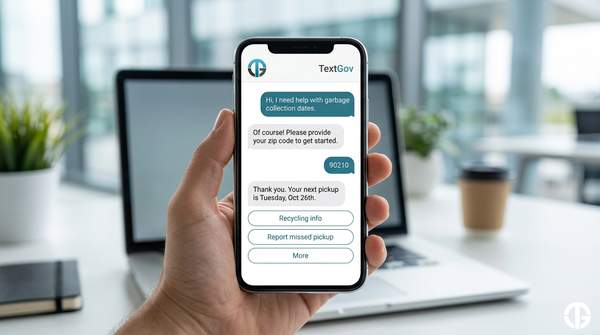
“Government chatbot” can sound like an organization-wide technology project before anyone has decided what the first useful deployment should actually cover. A city or county may have multiple departments, hundreds of pages of public information, separate service systems, and very different inquiry patterns across utilities, permitting, records, public works, and other functions.
TextGov gives agencies a narrower starting option. Its Government Chatbot can begin as a single-department pilot, including utilities-only or permits-only deployments, so the first launch can be built around one defined service area before the agency decides whether broader coverage makes sense.
A First Deployment Does Not Need to Cover the Whole Organization
A Government Chatbot can eventually span multiple departments, but expanding the first project to every public-facing service also expands the source material, workflows, stakeholders, and system connections that need to be considered.
TextGov supports focused departmental pilots that reduce that initial scope. Instead of trying to prepare an entire city or county at once, an agency can begin with one service area whose recurring questions and public information are already well understood.
That changes the buying decision from “How do we deploy AI across government?” to something much more concrete: “Which department has a defined communication job that a chatbot could handle first?”
Define What Goes Into the Pilot
A useful pilot needs a boundary. TextGov builds Government Chatbots around agency-approved information such as website content, policies, ordinances, forms, fee schedules, procedures, and other selected material.
For a one-department rollout, the initial scope can stay attached to the information that department already maintains. A utilities pilot might concentrate on billing questions, service information, forms, and common account-related directions, while a permitting pilot could focus on requirements, application steps, fees, forms, and approved procedural information.
A practical pilot scope can be summarized in four parts: