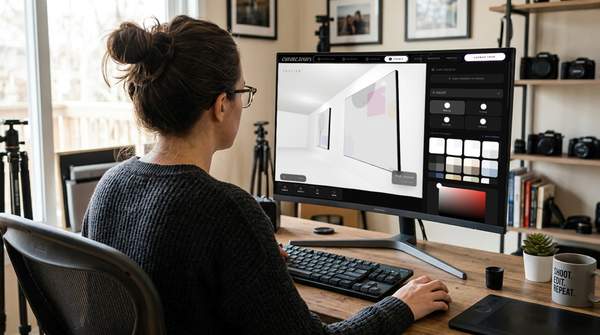
Venture capitalists are valuing Anthropic at up to $800 billion, more than double its February valuation, according to PYMNTS. This surge in valuation stems from investor confidence in Claude Design, Anthropic's new AI design tool. Claude Design promises to generate entire websites and app mockups from a simple text prompt, a significant advancement in AI's ability to create functional digital assets. Anthropic introduced Claude Design, its first proprietary AI design tool, according to CNET, fundamentally changing how product development begins.
However, despite AI's rapid progress in generating functional prototypes from text prompts, the design industry remains largely reliant on traditional, manual software and workflows. This creates a clear tension between emerging automated capabilities and entrenched professional practices. Claude Design, an experimental product, allows users to create visuals like prototypes and slides using Claude, according to TechCrunch. Its introduction forces traditional design software giants to either acquire similar AI capabilities or rapidly innovate, lest they become legacy tools for initial ideation.
Therefore, companies that fail to integrate AI-driven design into their product development cycles risk being outpaced by more agile competitors. These competitors can iterate on product ideas at unprecedented speed, turning weeks of traditional design work into minutes of AI-generated, functional prototypes. This will lead to a significant shift in market leadership within the design and prototyping space. Anthropic's astronomical valuation, driven by its design capabilities, confirms that market value is shifting towards AI-driven creation, compelling established players to adapt or face obsolescence.
Beyond Static Mockups: AI's Leap to Functional Prototypes
Anthropic plans to release Claude Opus 4.7, its new model, alongside an AI-powered design tool. This tool can generate websites, landing pages, and presentations from natural language prompts, according to PYMNTS. This capability transcends simple visual mockups, providing a direct pathway from concept to executable code. The tool’s advanced functionality fundamentally shifts the paradigm from static design to executable ideation, dramatically accelerating the design-to-development cycle for product teams. This implies a future where design is not just visual, but inherently functional from its inception.
Claude Opus 4.7 has demonstrated the capacity to build a single-file HTML task board complete with drag-and-drop functionality, filtering options, and local storage persistence, according to tomsguide. This capability extends beyond mere visual representation, showcasing the AI's ability to generate interactive, working prototypes directly from text. Such a tool allows product managers and developers to quickly visualize and test ideas without specialized design software or extensive manual coding, democratizing early-stage product development. The implication is a significant reduction in the barrier to entry for product innovation, allowing more ideas to be tested faster.
The AI also designed a single-screen ordering app mockup for a cold pizza company, featuring an editorial/deli aesthetic, tomsguide reports. This proves Claude Opus 4.7’s capacity for nuanced aesthetic choices and functional layout generation. These capabilities mark a leap from static image generation to functional, interactive, and context-aware design outputs. This fundamentally changes the prototyping process by accelerating iteration and reducing manual effort. By enabling non-designers to rapidly generate functional, interactive prototypes from natural language, Claude Design will disrupt traditional design workflows, shifting value from manual execution to strategic prompt engineering.
The Shifting Sands of the Design Software Market
Adobe reported $23.77 billion in revenue for fiscal year 2025, according to PYMNTS, confirming a robust market for traditional design software. Adobe's $23.77 billion revenue for fiscal year 2025 confirms the entrenched position of incumbent design tools. However, Claude Design’s capacity to automate and accelerate initial prototyping could commoditize a significant portion of early-stage design work. This forces established players to either acquire similar capabilities or pivot their focus towards advanced production and refinement tools. The implication is a potential bifurcation of the design software market, with AI handling initial ideation and traditional tools specializing in high-fidelity finishing.
Claude Design can create slide decks, social media assets, app and web interfaces, and other visual prototypes, according to CNET. This breadth of application positions it as a direct challenger across various creative tasks, not solely app or web development. While Adobe dominates the established design ecosystem, Anthropic is building a parallel, AI-accelerated design pipeline. This pipeline could bypass traditional tools for initial concept and prototyping, potentially siphoning off future design work rather than directly competing for existing Adobe users. This suggests a strategic threat that redefines the competitive landscape, moving beyond direct feature comparison to workflow disruption.
The breadth of Claude Design's applications, combined with its underlying model's comprehensive capabilities, positions it as a direct challenger to established design ecosystems. It also acts as a catalyst for new, more integrated product development workflows. Claude Design's ability to generate functional prototypes from simple text prompts democratizes early-stage product development. It empowers non-designers to bring ideas to life, fundamentally altering the traditional gatekeeping role of specialized design teams and increasing overall organizational agility. This shift will likely lead to flatter organizational structures in product development, as fewer dedicated designers are needed for initial concept work.
Navigating the New Era of AI-Powered Design
Claude Design offers diverse and flexible input methods. Users can initiate projects with text prompts, upload documents in formats like DOCX, PPTX, or XLSX, point Claude at their existing codebase, or utilize a web capture tool, according to 9to5Mac. This accessibility allows non-designers, such as product managers and developers, to visualize and iterate ideas quickly, reducing dependency on specialized design teams for initial concepts. This democratizes early-stage product development, increasing overall organizational agility and accelerating time-to-market. The implication is a significant reduction in the lead time for conceptualization and initial prototype creation, enabling faster feedback loops and iterative improvements.
If current trends persist, incumbent design software companies like Adobe will likely face increasing pressure by Q3 2026 to integrate similar AI-driven prototyping capabilities or risk losing significant market share in early-stage ideation to more agile, AI-powered solutions.